Customer Service WeChat
August 2026
Centered on the Belt and Road Initiative (BRI), the SLUGU International Innovation Education Center has developed a research system built around the frontier applications of Hexie Mangement Theory, the Half-Beat-Ahead Theory, and the Economic and Cultural Gateway Theory. Guided by the vision of a community with a shared future for humanity and taking the BRI as its pathway to practice, this system features an overall “8 + N” architecture: eight theoretical achievements span theoretical innovation, cognitive dimensions, historical perspectives, practical pathways, and strategic planning, while its industry applications encompass innovative education, AIGC, AI-enabled intelligent manufacturing, AI-enabled modern services, overseas-expansion services for enterprises, investment-banking services, and an innovative ecosystem integrating industry and education.
Investment-environment analysis and strategic guidance for Chinese enterprises expanding into Central and Eastern Europe
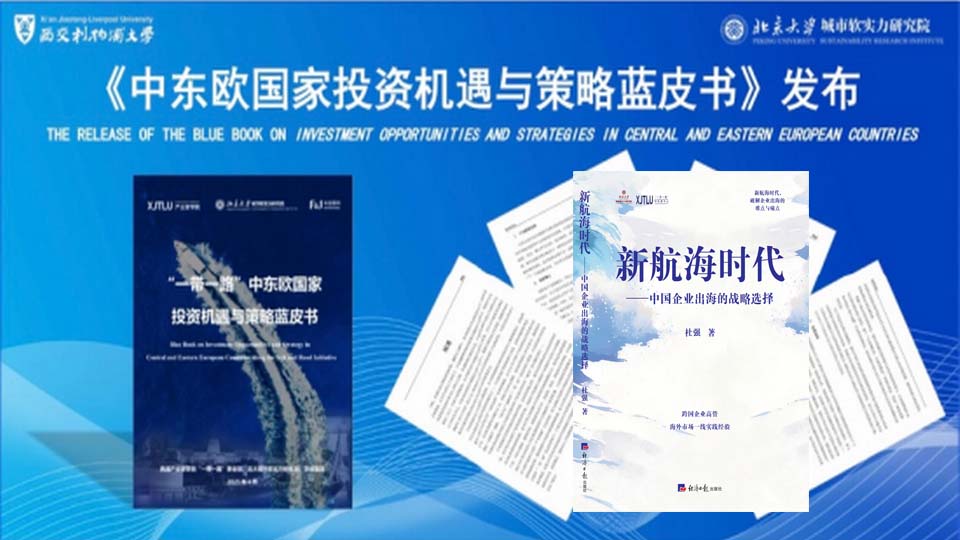
The Blue Book on Investment Opportunities and Strategies in Central and Eastern European Countries systematically analyzes the region’s investment environment, policy trends, risks, and challenges. It identifies investment opportunities and provides strategic guidance for Chinese enterprises entering Central and Eastern European markets. The study also supplied the preliminary research needed to implement industry–education integration initiatives, including the XJTU–SLUGU Business School and the DEEP Robotics–SLUGU (Central and Eastern Europe) Innovation Center.
A localized responsibility framework led by chambers of commerce, put into practice by enterprises, and supported by think tanks
Grounded in the Economic and Cultural Gateway Theory, this framework conceptualizes the overseas business environment as four interconnected “gateways”: economic structures, social interaction, rules and institutions, and shared ideas and consensus. At its core, the framework calls on Chinese enterprises operating overseas to translate their responsibilities into locally appropriate practices that respond to realities at each level, while coordinating implementation across all four levels to ensure alignment and avoid contradiction. It further explains that Chinese enterprises, as institutional carriers of the vision of a community with a shared future for humanity, should systematically integrate social responsibility into local operations in accordance with internationally accepted rules—progressing from compliance-based responsibility to collaborative value creation and ultimately contributing to the sustainable development of partner countries participating in the BRI.
The theoretical foundations and contemporary value of an original Chinese management theory for innovative education integrating industry and education under the BRI
To address the complex governance challenges confronting Chinese institutions expanding into Central and Eastern Europe, we have systematically applied Hexie Mangement Theory, founded by Professor Xi Youmin, to cross-cultural governance practices. This work has led to the successive establishment of the Xi’an Jiaotong–SLUGU Business School, the DEEP Robotics–SLUGU (Central and Eastern Europe) Innovation Center, and the Micot–SLUGU (Central and Eastern Europe) Biopharmaceutical Innovation Center, among other institutions, thereby continuously deepening the theory’s application to industry–education integration.
The leading role of AI and cultural soft power as first movers in the overseas expansion of modern services
Jointly proposed by renowned economist Professor Xu Dianqing and Dean Geng Jian, the Half-Beat-Ahead Theory is a forward-looking strategic approach applicable across a wide range of endeavors. Its central principle is to establish a relative lead in critical areas: accurately identify emerging opportunities, move proactively in directions where conditions and potential are favorable, and stay one step ahead so as to secure the initiative in competition. Drawing on the defining features of the AI era, Dean Geng Jian has creatively developed a dual-engine model—“AI + Culture”—to lead the global expansion of modern services and support practical applications across countries and industries.
Building a future-oriented cognitive compass through a global outlook and historical-dialectical thinking
At a time of intensifying competition among major powers, confrontational narratives such as the “Thucydides Trap” are becoming cognitive traps that impede global cooperation. In Navigational Coordinates for the New Age of Navigation: Cognitive Dimensions for Anticipating the Future, Dean Geng Jian draws on the principle that civilizations advance through mutual learning. From a global perspective, the book examines pivotal changes and emerging trajectories amid transformations unseen in a century, and uses a global outlook and historical-dialectical thinking to construct a future-oriented cognitive compass. It helps readers locate themselves amid complex change and develop a broader strategic perspective.
A theoretical architecture enabling Chinese institutions to fulfill social responsibilities overseas and integrate into host-country sustainable development
To fill a gap in BRI research concerning the two-way transmission of economic and cultural forces—and to address cognitive mismatches encountered by enterprises expanding overseas—we apply the Economic and Cultural Gateway Theory to BRI, regional, and country studies. The theory situates international business and economic cooperation within local social and cultural contexts. It develops a dynamic, cyclical model comprising economic structures, social interaction, rules and institutions, and shared ideas and consensus; establishes a two-directive mechanism for economic-cultural gateway alignment and feedback; and offers replicable localization solutions. In doing so, it guides enterprises in embedding themselves within local societies and achieving sustainable development.
An innovative model for the international development of industry–education integration in Chinese universities under the BRI
This is China’s first five-in-one empowerment curriculum for industry–education integration. For students in China, it encompasses five dimensions: a foundation in cognitive and psychological well-being; a historically informed global outlook; motivation to unite knowledge with innovative practice; end-to-end AI empowerment and application; and capital-oriented thinking in investment and wealth management. Designed for internationally oriented high-school, undergraduate, and postgraduate students with strong potential, the curriculum builds a complete talent-development cycle through standardized class hours, structured knowledge points, industry-level cases, and a strategic-level perspective. It is an original, independently developed program tailored to the growth of globally minded Chinese youth in the new era.
For prospective international students preparing to study in China through overseas learning centers, the curriculum’s five modules cover five knowledge dimensions: contemporary Chinese culture and governance, the modern economy, scientific and technological innovation, digital and AI industries, and the globalization of Chinese enterprises. Standardized in architecture, systematic in its knowledge framework, and oriented toward contemporary realities, the curriculum is specifically designed around the learning needs of international students coming to China. It addresses the fragmented content and structural gaps of traditional general-education courses and provides overseas learning centers with an empowering curriculum for developing a well-rounded understanding of China.
Drawing on multinational investment-management experience to develop strategic options for Chinese enterprises’ global expansion
To address the problems of indiscriminate overseas expansion and the lack of quantitative decision-making tools among Chinese enterprises, Dr. Du Qiang, Executive Director for Industry–Education Integration at the SLUGU (Central and Eastern Europe) Center, has drawn on the investment-management experience of multinational enterprises to develop an end-to-end, actionable methodology. This work culminated in the monograph The New Age of Navigation, published by Economic Daily Press. The book transforms overseas-expansion processes and decisions from intuition-driven ventures into a scientifically structured process that can be assessed quantitatively, helping Chinese enterprises create value globally.
Against the backdrop of the global two-way restructuring of education and industry, SLUGU, as an international industry-education integration platform rooted in the university system, upholds the "industry-academia-research-government-society" five-in-one collaborative model. It promotes deep integration of premium European educational resources with China's top universities and leading enterprises, helps European universities expand their cooperation footprint in China, and achieves two-way internationalized education, research innovation, and closed-loop delivery of industry talent.

热线电话
0086-13361996651
上班时间
周一到周五